

Every payslip on time, the certificate ready in January
You enter the gross, LUXPOS works out the Luxembourg contributions, the net payable and the employer cost. The payslip goes out as a PDF laid out like a local décompte, and the annual certificate is built from the finalized slips. Both documents are shown further down, full size.
- Gross to net on Luxembourg rates
- Payslip and certificate as PDF
- Verified rates from 2021 to 2026
Payroll for a small business should not live in a spreadsheet
- The payroll spreadsheet is copied every month, and one forgotten formula repeats itself for a year.
- Contribution rates and the ceiling move with the wage index, and nobody knows which version the file holds.
- The annual certificate is rebuilt by hand out of twelve payslips.
- Assignments and garnishments are tracked on a scrap of paper, and nobody knows what is still outstanding.
Three things that run differently at month end
No percentage promises. Only what follows directly from the way the module works.
The same payslip, different pressure
Full-time, part-time and casual staff in one run, each on their own contracted share and hourly rate.
Saturday staff and part-timers on different contracted hours, every slip with its own figures.
Bonuses and benefits in kind on their own line, visible instead of buried in the gross.
Five fixed salaries, the same figures every month, one run per month.
- Restaurants, cafés and shops with a handful of staff.
- Independents employing one to five people who want out of the spreadsheet.
- Businesses that prepare the payslips themselves before handing them to their fiduciaire.
- Multi-branch businesses that want one view of the wage bill.
This is what comes out of the module
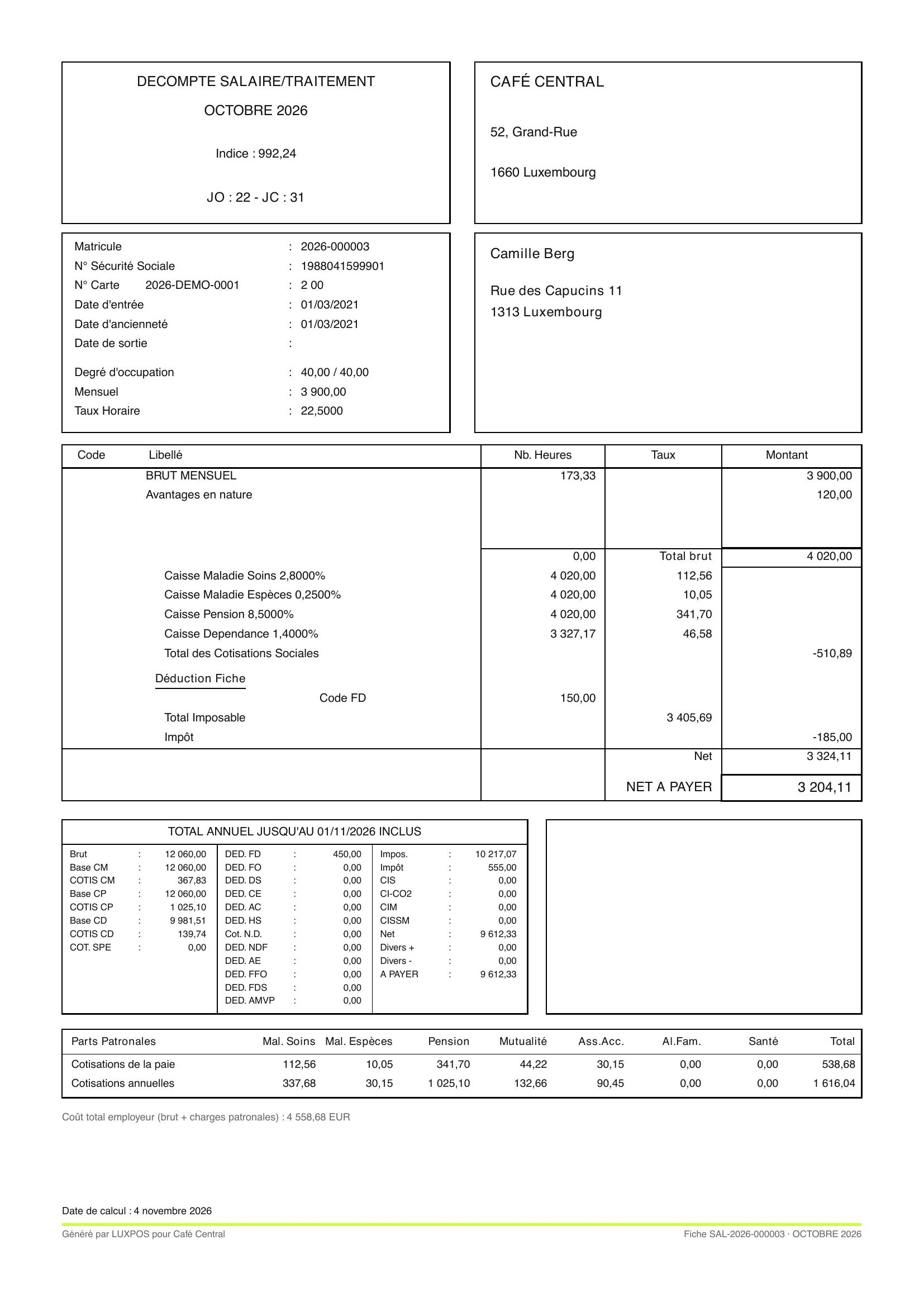
Both sheets are A4 prints from the same generator that runs in your account. Tap the sheet to zoom in.
Décompte salaire, October 2026
The monthly slip as the employee receives it. Structure and wording follow what a Luxembourg payroll bureau prints.
- Wage index and days of the month
- The header carries the month's index plus JO and JC, the working days and the calendar days.
- Every contribution with its base and rate
- Caisse Maladie Soins 2.8000 %, Espèces 0.2500 %, Pension 8.5000 %, Dépendance 1.4000 %, each with its base next to it. Dependency visibly runs on a smaller base.
- Net and net payable
- Taxable total, tax, net, and below it the amount actually transferred, after garnishments and other deductions.
- The year on the same sheet
- The Total annuel jusqu'au ... inclus box totals gross, bases, contributions, tax and net from the finalized slips.
- Employer shares in the open
- Employer shares for the month and for the year, with mutuality and accident insurance, and below them the month's total cost.
The PDF is generated in French. The business and the person in the example are invented; the rates are the real ones.
One monthly run, one list
Gross, net payable, employer cost and the number of active employees sit above the list. The bar shows how many of the month's slips are already settled.
- Payslips, employees and absences in three tabs
- Month back and forward, or every month at once
- Social parameters and certificates straight from the header
From gross to net, through to the annual certificate
Payroll sits inside LUXPOS accounting: the same people, the same periods, the same exports. Here is what it actually does.
The net is calculated live
Enter the gross, benefits in kind, hours, garnishments and other deductions. The preview immediately shows social contributions, the RTS you entered, net payable, taxable income and employer cost.
CCSS social parameters
Wage index, monthly and annual contribution ceiling, dependency allowance, social minimum wage and the sickness, pension and dependency rates for employee and employer. Values are read from the official CCSS page every day, dated and sourced, with a verified fallback barème and a per-year history.
The payslip PDF
Every slip carries a number, a period and a status: draft, finalized, paid. The PDF follows the layout of a Luxembourg décompte, with the annual cumulative totals and the employer shares, and the rate set used stays frozen on the slip.
Salary certificate
The annual certificate is built per employee from the finalized payslips, on the official form with its numbered lines. It stays a draft, and locks on the day you issue it.
The employee file
Matricule with 13 digits, tax class, contract type, job title, monthly gross, IBAN, hire date and seniority. The tax card and the contract are attached to it, and every change leaves a trail.
Absences and remaining leave
Absences are recorded by type and period. Days are counted Monday to Friday, the eleven Luxembourg public holidays never consume a leave day, and the balance shows in the employee file.
There is also
Recorded with creditor, total amount and monthly instalment. Every slip deducts the instalment and the remaining balance comes down on its own.
Who changed which field and when, with the value before and after.
Tax card, contract and attestations stay attached to the employee instead of sitting in a binder.
Three steps, every month
Create the employee file
Name, matricule, tax class, contract type and monthly gross. Once per employee.
Produce the month's payslip
Pick the employee and the period, enter the gross, check the calculation preview, save as a draft and finalize.
Hand over, pay, file
Download the PDF, hand it to the employee and mark the slip paid. At year end, build the salary certificate from the finalized payslips.
Written for Luxembourg
Luxembourg payroll has its own landmarks: the wage index, the contribution ceiling, the dependency allowance, the qualified and unqualified minimum wage. The module tracks them and tells you where the numbers come from.
- Wage index (cote d'application) with its effective date, printed on the slip.
- Monthly and annual contribution ceiling, dependency allowance, qualified and unqualified SSM.
- Sickness 3,05 %, pension 8,50 % in 2026, dependency 1,40 %: employee and employer share shown separately.
- Dependency is computed on the gross less the allowance and knows no ceiling. The slip shows that line by line.
- Accident insurance and employer mutuality: business-specific rates assigned by the AAA and the CCSS, entered per payslip.
- The RTS is entered from the ACD barème or the employee's tax card.
- Contribution rates and the RTS barème must be verified with the CCSS and the ACD before production use.
What LUXPOS does not do
So the handover to the fiduciaire holds no surprises.
- No filing with the CCSS. Entries, exits and the monthly declaration stay with you or with your fiduciaire.
- No retrieval of the tax card from the ACD. The RTS is entered from the barème or from the employee's card.
- No payment. There is no SEPA file: you pay from the bank account, then mark the slip paid.
- No premium calculation. Sunday, night, public holiday and overtime are entered as a line whose amount you supply.
- No link to the ADEM.
Payslip questions
- How do I produce a payslip in LUXPOS?
- Create the employee file once, then open a new payslip for the period. You enter the gross, the net is calculated live and the slip is saved as a draft. Finalize it when it is right, then download the PDF.
- Is the net calculated automatically?
- Social contributions, taxable income, net payable and employer cost are calculated from the social parameters in force. The RTS is entered from the ACD barème or the tax card: LUXPOS does not replace the tax scale.
- Are the contribution rates up to date?
- Social parameters are read from the official CCSS page every day, with the fetch date and the source shown. If the source cannot be reached, the module falls back to a verified barème covering 2021 to 2026 and says so. Before production use, verify the rates with the CCSS and the RTS barème with the ACD.
- Are Sunday, night and overtime premiums calculated?
- No. The hours are recorded on the slip and the premium is entered as a separate line with its amount: LUXPOS applies no premium rate, tracks no compensatory rest and grants no extra leave days for Sunday work. The premium calculator belongs to the HR module, which is still being built.
- What is the salary certificate?
- It is the annual summary per employee, on the tax administration's official form with its numbered lines. LUXPOS builds it from the year's finalized payslips and totals gross, contributions, RTS and net. It stays a draft until you issue it.
- Does LUXPOS replace my fiduciaire?
- No. The module produces payslips, certificates and absence tracking. No declaration is filed with the CCSS or the ACD from LUXPOS and no payment file is generated: your fiduciaire keeps its role, with clean documents coming in.
- Are garnishments tracked?
- Yes. An assignment, a garnishment or a maintenance order is recorded with its creditor, total amount and monthly instalment. Every payslip deducts that month's instalment and the remaining balance comes down on its own.
- What language is the PDF in?
- French, as Luxembourg payroll paperwork usually is. The application itself speaks French, German, English, Italian and Portuguese.
- Which plan includes payslips?
- The payroll module is part of LUXPOS accounting and is available on the plans that include accounting. The detail is on the pricing page.
The other modules
See the payroll module on your own figures
We walk you through one payslip end to end, from the gross to the PDF, with the social parameters in force.